
Making Tax Digital
Explained Simply.
If you’re self-employed or a landlord in the UK, a major change is coming to how you report your income to HMRC.
Don’t worry – we’ve made this guide so simple that you’ll understand everything in 5 minutes.
April 2026
First Deadline for £50k+ earners
HMRC Recognised
Quarterly updates to HMRC
DIGITAL ONLY
Paper records won’t be accepted
Scroll to learn everything
The 60-Second version
MTD IN A Nutshell.
Here’s everything you need to know, explained as simply as possible
What is Making Tax Digital (MTD)?
- Making Tax Digital is the government's plan to modernise how you report your income. Instead of filing one annual tax return, you'll need to:
- Keep your records digitally using compatible software
- Send quarterly updates to HMRC (4 times a year)
- Submit a Final Declaration at year-end
Who Needs to Comply with Making Tax Digital in the UK
- MTD for Income Tax applies to sole traders and landlords whose annual income exceeds certain thresholds:
£50,000+
From April 2026
£30,000+
From April 2027
£20,000+
From April 2028
What you need to do.
1. Sign up with HMRC
Register for MTD for Income Tax on the GOV.UK website before your start date.
2. Get MTD Compatible Software
3. Keep Digital Records
4. Submit Quarterly
THE Good NEWS
- You don't need an accountant — the software does the hard work
- You don't need expensive software — affordable options exist
- Quarterly updates are NOT tax payments — you still pay once a year
- HMRC is taking a "light touch" approach in year one — no fines for small mistakes
Understand the difference
MTD FOR VAT VS MTD FOR IT
There are two separate MTD programmes. Here’s what each one means for your business
MTD for Income Tax is the new way for sole traders and landlords to report their income. It requires digital record-keeping and quarterly updates, making it easier to stay on top of your tax throughout the year.
What you need to do.
- Keep digital records of all business income and expenses
- Send quarterly updates to HMRC through compatible software
- Submit a Final Declation by 31st January
- Use MTD-compatible software recognised by HMRC
Powered Now + IT
Powered Now is built for tradespeople and is fully MTD for Income Tax ready. Track your income and expenses as you work, and we’ll handle the quarterly submissions to HMRC automatically.
Applies to sole traders and landlords above thresholds. Focuses on digital records + quarterly updates + a final year-end submission
If you’re VAT Registered, MTD for VAT applies. HMRC guidance states VAT registered businesses should now be signed up and you must use compatible software to keep VAT records and file VAT returns.
What you need to do.
- Use compatible software (or bridging software for spreadsheets)
- Keep digital records for VAT
- Submit VAT Returns through the software
Powered Now + VAT
Powered Now appears on HMRC’s VAT software list as record‑keeping software suitable for businesses or agents, including the ability to submit VAT Returns and view VAT payment history.
Applies to VAT registered businesses. Focuses on digital VAT record keeping + digital VAT return submission.
THE KEY CHANGES
HOW MTD CHANGES THINGS.
Here’s everything you need to know, explained as simply as possible
BEFORE MTD
Paper records & Spreadsheets
With MTD
DIGITAL SOFTWARE ONLY
You must use HMRC-recognised software to keep records. Paper and manual spreadsheets wont be accepted
BEFORE MTD
One Annual Tax Return
With MTD
Quarterly Updates + Year-end
You’ll send income/expense summaries to HMRC 4 times a year, plus a Final Declaration.
BEFORE MTD
Submit Manually Online
With MTD
Software submits for you
Your MTD software will connect directly to HMRC and submit your data automatically.
Important Dates
When does MTD start for me?
MTD will affect 2.9 million UK sole traders, with your start date based on total annual income.
Started Now!
APRIL 2026
Income £50,000+
First 864,000 affected.
Self-employed individuals and landlords with annual income over £50,000
APRIL 2027
Income £30,000+
An additional 1,077,000 will have to adopt digital practices.
Self-employed individuals and landlords with annual income between £30,000 – £50,000
1 year to prepare
APRIL 2028
Income £20,000+
Another 975,000 will have to adopt digital practices.
Self-employed individuals and landlords with annual income between £20,000 – £30,000
2 years to prepare
Quarterly Update Deadlines
Once MTD applies to you, you’ll send updates to HMRC 5 times per year. Each update is due one month after the quarter ends, followed by one final assessment.
Q1
6 April – 5 July
Deadline 7th August
Q3
6 October – 5 January
Deadline 7th February
Q2
6 July – 5 October
Deadline 7th November
Q4
6th January – 5th April
Deadline 7th May
FINAL DECLARATION
Deadline 31st January
After your 4 quarterly updates, you’ll submit a Final Declaration by 31st January the following year. This replaces the traditional Self Assessment tax return.
MTD THAT WORKS FOR TRADES
Why Powered Now?
Powered Now is a job management system for trade professionals, so the data needed for MTD is created naturally as part of the day-to-day workflow (quotes → invoices → expenses), helping records stay accurate and up to date — protecting your business from mistakes, missed deadlines, and HMRC penalties.
When MTD launches, there will be three ways to submit your digital returns:
1. Accounting systems
Xero, Quickbooks, Sage, Free Agent
HMRC
Not designed for trade companies.
2. other Job Management sYstems + Accounting
Job Management System
Xero, Quickbooks, Sage, Free Agent
HMRC
Complicated, expensive and more to learn.
3. Powered Now
Powered Now
HMRC
Simple, cost, effective, helps your business, compliance happens as a by-product.
Most job management systems still rely on separate accounting software to meet MTD requirements, meaning data has to be copied, synced, or reconciled later. Powered Now is different.
Because MTD-ready records are created automatically through everyday work like quoting, invoicing, and tracking expenses, compliance happens as a by-product of running the job, not an extra task at the end.
Going digital doesn’t make things harder — it makes things easy
While Making Tax Digital is a big change, it’s designed to reduce mistakes, improve accuracy, and remove the stress of last-minute paperwork. Digital records mean fewer errors, clearer reporting, and a much better view of your business throughout the year — not just at tax time.
Powered Now supports this shift by helping you run your jobs digitally from day one. It’s built for people who manage work on-site, not spreadsheets in an office. Everything is written in plain language, kept deliberately simple, and priced to stay affordable — without the over-complication of traditional accounting systems.
Still GOT QUESTIONS?
FAQ'S
Everything you need to know about Making Tax Digital, answered in plain English.
Do I need MTD for VAT?
If you’re VAT registered, you must keep VAT records digitally and file VAT Returns using compatible software (or bridging software).
When do I need to start MTD for Income Tax?
It starts from April 2026 for qualifying income over £50,000, then expands in 2027 and 2028.
What counts as qualifying income?
Qualifying income is gross income from self-employment and property (before allowances/expenses).
Do quarterly updates mean I’ll pay Income Tax four times a year?
No. Quarterly updates are summaries and the payment deadline remains 31 January.
Are quarterly updates the same as a tax return?
No—HMRC states they aren’t tax returns. The year-end submission still happens via software.
Can I keep using spreadsheets?
For VAT, HMRC allows bridging software to connect spreadsheets to HMRC.
For Income Tax, HMRC guidance also describes bridging software that connects to spreadsheet records and can submit updates/returns.
What if I miss something in a quarterly Update?
HMRC indicates you can add missed information in the next quarterly update.
What are the quarterly Deadlines?
Standard deadlines are 7 Aug, 7 Nov, 7 Feb, 7 May (aligned to the tax year).
What are the penalties if i'm late?
HMRC’s points-based system applies; for quarterly submissions (including MTD for ITSA) the threshold is 4 points and then a £200 penalty.
Do limited companies need to follow MTD for Tax income?
HMRC’s campaign guidance indicates limited companies do not need to use MTD for Income Tax (though they may have MTD for VAT if VAT registered).
What about partnerships?
HMRC’s campaign guidance says partnerships will be required in the future, but not yet (timeline to be set later).
Can I get an exemption?
HMRC outlines exemptions for digital exclusion (for example, due to age, disability, health, location, or religious grounds).
Get MTD READY
Start your free trial today
Join thousands of UK tradespeople who trust Powered Now to handle their invoicing, certificates, and now MTD compliance. Get set up in minutes, not hours.
- HMRC-recognised MTD software
- Built specifically for UK tradespeople
- Quotes, invoices, and certificates included
- Automatic quarterly updates to HMRC
- No accountancy knowledge required
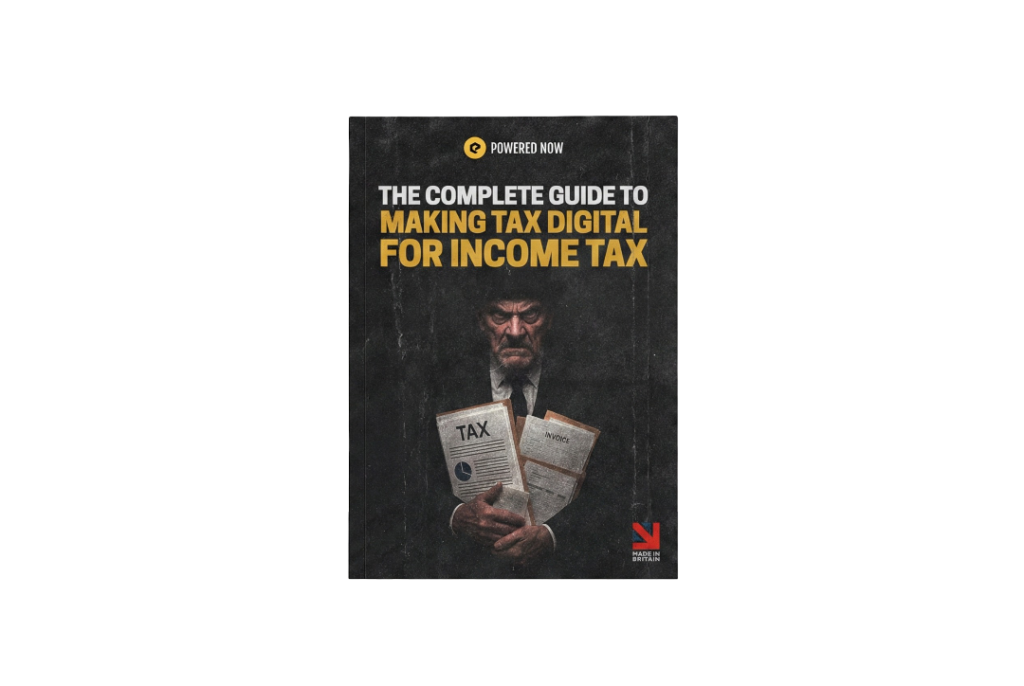
FREE MTD GUIDE
Download our complete guide to Making Tax Digital for Income Tax